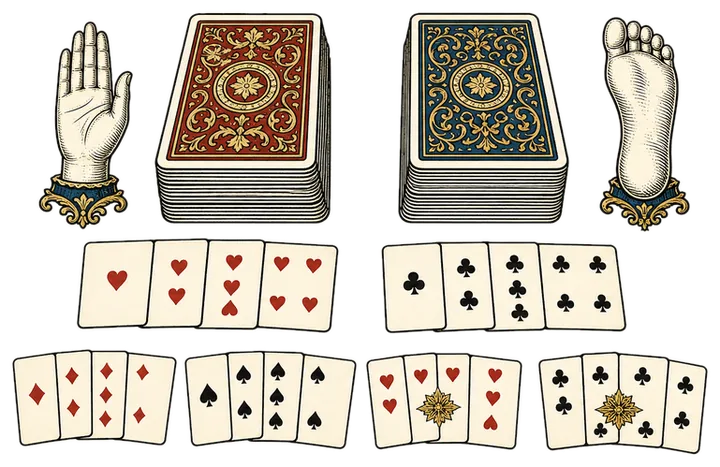
- Players
- 4
- Time
- 1–2 hours
- You need
- 5 decks with jokers
- To win
- Team with most points after 4 rounds
Playing online here
You sit opposite your partner; the other two seats are the other team. To keep turns quick, this version always draws from the stock (no picking up the discard pile), and going out needs two clean and two dirty books with your partner in their foot. Everything else follows the rules below.
Hand and Foot score keeper
Playing at the table? Enter what each team has down and left over, and the score keeper adds it up.
| Cards | On the table | Left in hand/foot |
|---|---|---|
| Jokers | ||
| 2s and aces | ||
| 8 to king | ||
| 4 to 7 | ||
| Black 3s | – |
Round 1: 0
| Cards | On the table | Left in hand/foot |
|---|---|---|
| Jokers | ||
| 2s and aces | ||
| 8 to king | ||
| 4 to 7 | ||
| Black 3s | – |
Round 1: 0
Team 1
0
0 · 0 · 0 · 0
Team 2
0
0 · 0 · 0 · 0
Hand and Foot rules
Hand and Foot is a canasta-style game, usually for four players in two partnerships sitting opposite each other. A game is four rounds. Rules vary a lot between families; these are the most common ones.
Decks and deal
- Use one more deck than players, jokers included: five decks for four players.
- Each player gets two piles of cards: the hand and the foot, commonly 13 cards each. Play your hand first; the foot stays face down until your hand is used up.
Wild cards and threes
- Twos and jokers are wild.
- Red 3s are laid down straight away for 100 points each; caught in your hand at the end, they cost 100.
- Black 3s can't be melded and cost 5 points if left in your hand.
A turn
- Draw two cards from the stock.
- Meld cards on the table: three to seven cards of the same rank. Your team shares its melds.
- Discard one card.
A meld may have more natural cards than wild ones. Seven cards make a book: a clean book has no wild cards, a dirty book has some, and a wild book is all wild cards.
Opening meld
Each team's first meld of a round must be worth at least:
| Round | Minimum |
|---|---|
| 1 | 50 |
| 2 | 90 |
| 3 | 120 |
| 4 | 150 |
Going out
Once your hand is gone, pick up your foot. To end the round, your team needs two clean books, two dirty books and one wild book; your partner must have reached their foot; and you ask their permission. Then meld or discard your last cards.
Hand and Foot scoring
| Item | Points |
|---|---|
| Joker | 50 |
| 2 or ace | 20 |
| 8 to king | 10 |
| 4 to 7 | 5 |
| Black 3 left in hand | −5 |
| Clean book | 500 |
| Dirty book | 300 |
| Wild book | 1,500 |
| Red 3 | 100 (−100 if not laid down) |
| Going out | 100 |
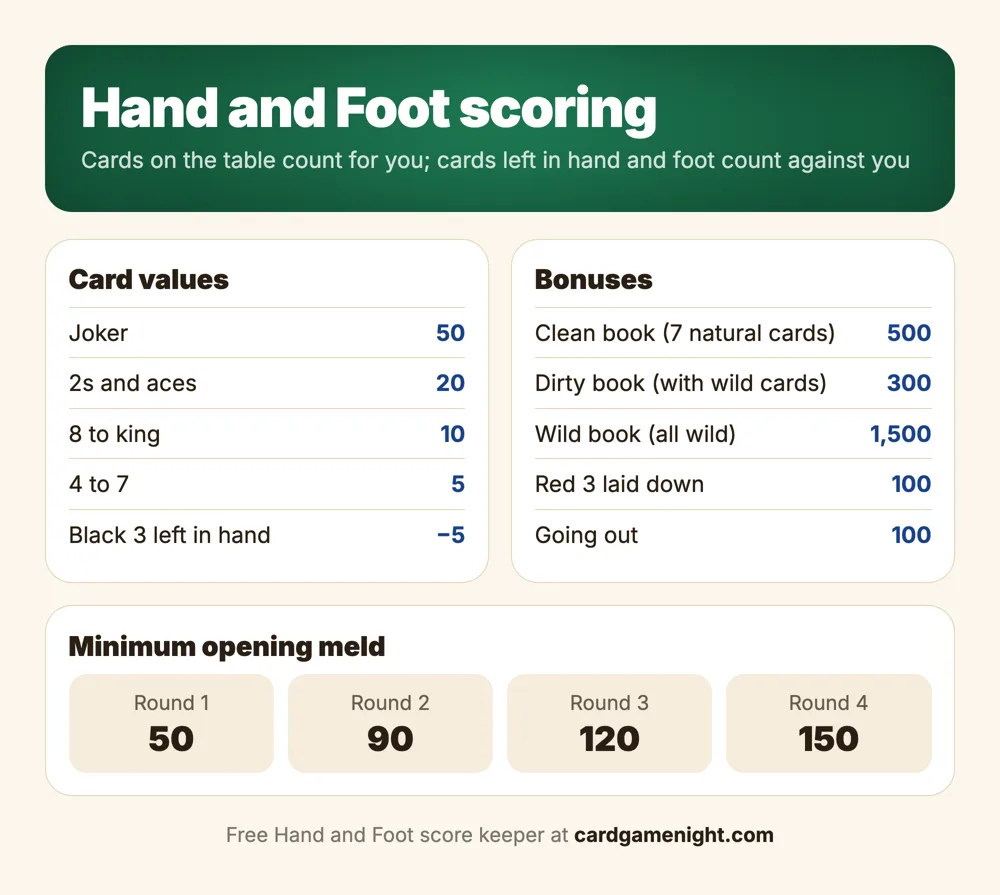
Cards melded on the table count for you; cards left in your hand and foot count against you. The team with the highest total after four rounds wins. Use the score keeper above to add it all up.
Frequently asked questions
How many decks do you need for Hand and Foot?
One more deck than the number of players, with jokers: five decks for four players. Many families use a dedicated Hand and Foot set.
How many cards are in the hand and the foot?
Commonly 13 in each. Some groups deal 11 cards. You play the hand first and pick up the foot once your hand is gone.
What is a clean book in Hand and Foot?
A meld of seven cards of one rank with no wild cards. It's worth 500 points. A dirty book contains wild cards and is worth 300.
What do you need to go out in Hand and Foot?
In the most common rules, the team needs two clean books, two dirty books and one wild book, a partner who has reached their foot, and the partner's permission.
How much are red 3s worth?
Plus 100 each when you lay them down, and minus 100 each if they're still in your hand or foot at the end.
What is the opening meld in each round?
Round one 50 points, round two 90, round three 120 and round four 150. Only the card values count toward it, not bonuses.